

MotifChord-Base
MotifChord-Base is a 172 M parameter decoder-only causal language model built around two ideas: a 3:1 hybrid of linear-time gated delta-net layers and exact chord attention, and a learned attention residual inside every block instead of a fixed additive one. It is small enough to run on a CPU or a single consumer GPU.
Model details
| Field | Value |
|---|---|
| Architecture | Decoder-only causal LM, hybrid gated delta-net + chord attention, intra-block attention residual |
| Embedding | 40,960 × 768, tied to the output head |
| Layers | 4 blocks × 4 sub-layers = 16 layers; each block holds 3 gated delta-net layers and 1 chord layer |
| Attention heads | 12 query heads / 3 kv heads (GQA); key head dim 64 for the gated delta-net, value expansion 2 |
| Context | Trained in stages from 1024 up to 4096 tokens; the inference cache has no fixed limit |
| License | Apache-2.0 |
| Source | https://github.com/CodonProject/codon-motif |
Architecture
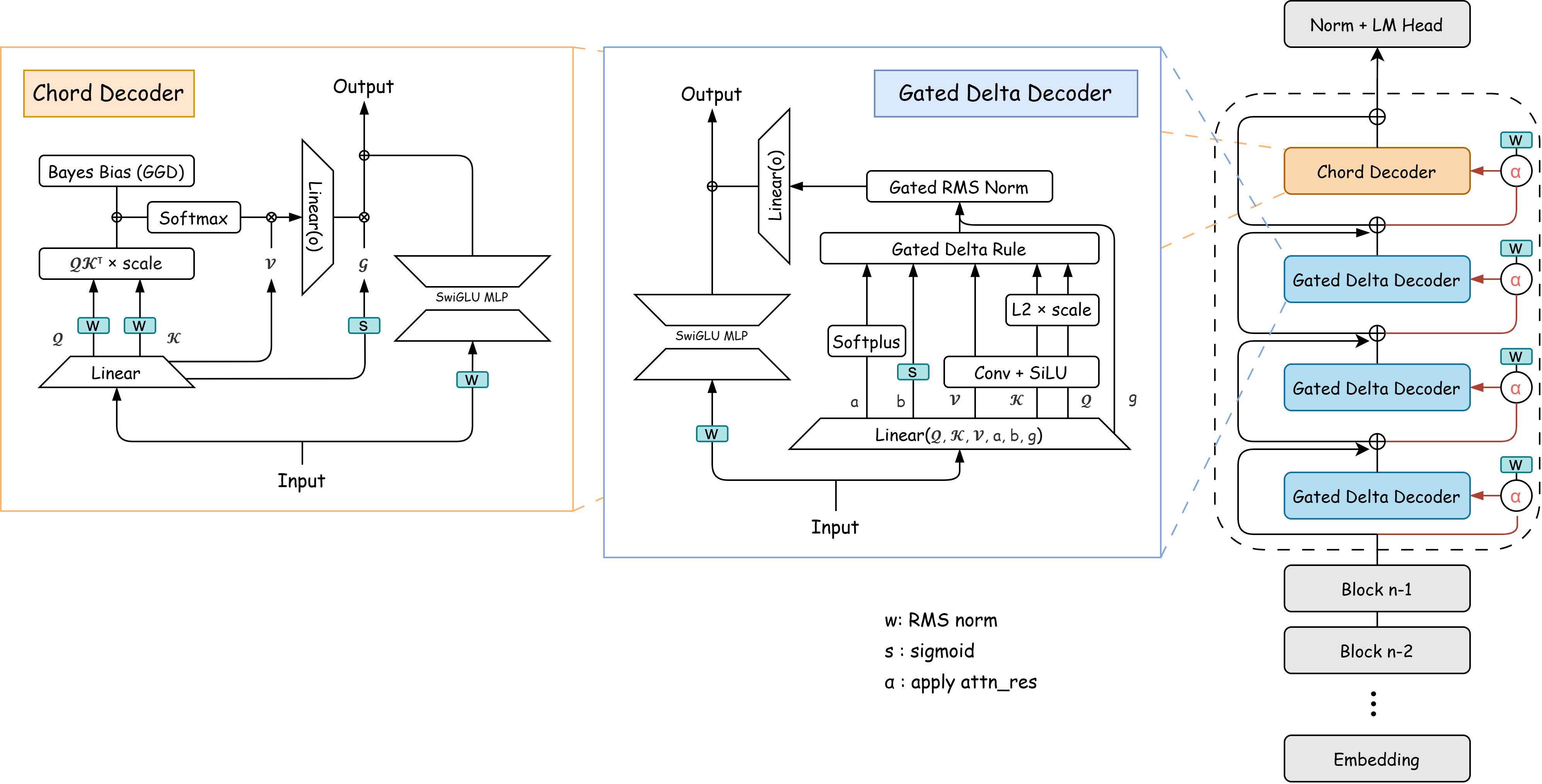
The stack is an embedding, four blocks and a final RMSNorm + LM head. Inside a block, four sub-layers run in sequence; each one is a parallel attention-and-MLP residual, x = x + attn(norm(x)) + mlp(norm(x)), 768 wide, with a SwiGLU MLP.
- Gated delta-net carries three of the four sub-layers with a linear-time chunked recurrence. Its state is a fixed-size matrix, so the memory a long sequence costs does not grow with its length. A short causal convolution (Conv1d + SiLU) sits in front of q, k and v.
- Chord attention is exact softmax attention whose scores carry a gated geometric-decay bias,
-alpha * (|d - mu| + eps) ** beta, withalpha,betaandmulearnable per head (muis frozen). This stands in for RoPE — a Bayesian positional prior at the cost of a few parameters per head, and no position table to extend. - Intra-block attention residual makes each sub-layer read the outputs of the earlier sub-layers in the same block through a learnable query vector and an RMSNorm, instead of the fixed
x + f(x). It is the lightweight intra-block form of Attention Residuals (Kimi Team), not a global aggregation across blocks. A fused Triton kernel implements the read, with an eager fallback when a call does not qualify. In the figure,wmarks an RMSNorm,sa sigmoid gate andaan attn-res read.
The architecture follows Gated DeltaNet (Yang et al., 2025), Attention Residuals (Kimi Team, 2026), the Bayesian Attention Mechanism (Bianchessi et al., 2026) and the Qwen3 hybrid-attention recipe.
Intended use
- Primary: text completion and continuation with the base weights; research on hybrid attention, linear-attention recurrence and attention residuals; a small local model for CPU or single-GPU experiments.
- Out of scope: instruction following, chat, tool use, retrieval, safety-critical or production decisions, and any use that treats the output as factual. The weights have had no instruction tuning and no alignment; the model continues text, which includes continuing it badly.
Post-training and a chat template exist for development, but no chat checkpoint is released. With these weights, use plain text completion.
How to use
pip install codon-motif
from motif.model import MotifChordModel, Sampler, TextGeneration
from motif.tokenizer.tokenizer import PackedTokenizer

tokenizer = PackedTokenizer('tokenizer.zip')   # shipped in the repository root
model = MotifChordModel.from_pretrained('MotifChord-Base.safetensors').eval()

generation = TextGeneration(
    model,
    tokenizer,
    'The capital of France is',
    max_new_tokens=64,
    sampler=Sampler(temperature=0.0),   # greedy
)
print(generation.run().text)
from_pretrained accepts a safetensors file or shard directory (with an optional config.json sidecar), a bare PyTorch state dict, and the training checkpoints written by this project's pipelines. When a file carries no config, the hyper-parameters are recovered from the tensor shapes.
Sampling
Sampler(temperature=0.0) is deterministic: the temperature is clamped to 1e-5, so the multinomial collapses onto the top token. Note that the repetition penalty still applies at temperature 0 (repetition_penalty=1.15 by default); pass repetition_penalty=1.0 as well for a plain argmax. For sampled text, temperature in 0.7-1.0 with top_k=50 or top_p=0.9 is a reasonable starting point.
Prompt format
The base weights were trained on raw text, so a plain prefix is the right prompt. The chat template (<|im_start|>, <|thought_start|>, effort tokens, <|tool_call_start|>, ...) occupies 256 reserved special-token slots in the vocabulary; using it with the base weights is not meaningful.
Training
| Field | Value |
|---|---|
| Tokens | 13.78 B |
| Steps | 4,042,962 (the last checkpoint records step = 4042960) |
| Sequence length | 1024 → 2048 → 4096, progressive |
| Hardware | one 32 GB consumer GPU |
| Final loss | cross-entropy ≈ 2.9 on the pretraining mixture |
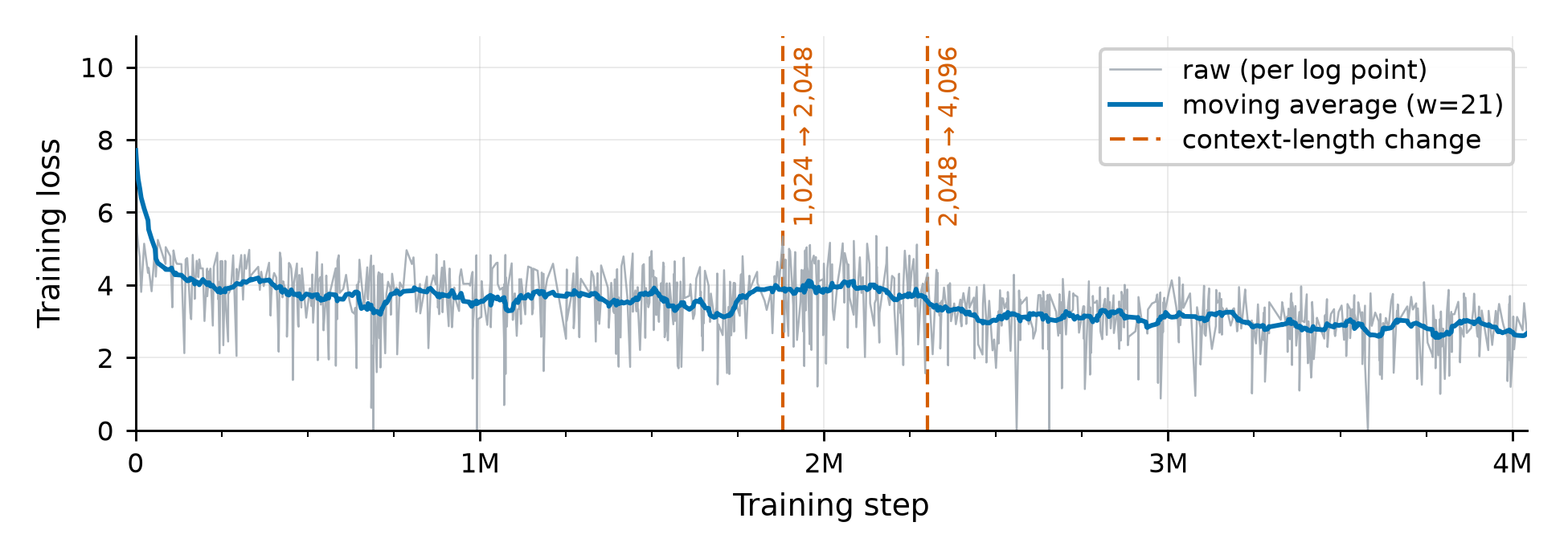
The stages the published curve marks with dashed lines:
| Stage | Sequence length | Batch size | Tokens | Steps | Ends at step |
|---|---|---|---|---|---|
| Foundation | 1024 | 4 | 5.77 B | 1,877,825 | 1,877,825 |
| Expansion | 2048 | 2 | 0.86 B | 422,048 | 2,299,873 |
| Stabilization | 4096 | 1 | 7.14 B | 1,743,089 | 4,042,962 |
Training loss, raw per log point and as a 21-point moving average, with the two context-length changes marked:
Pretraining data: UltraData-Code, arXiv Complete, WMT17 Zh-En, Nemotron-CC-Math-v1, Ultra-FineWeb-L3 (citations in the repository README). No data filtering, deduplication or contamination analysis is published, and no evaluation benchmark suite was run.
Evaluation
No task benchmark (held-out perplexity, MMLU, HellaSwag, ...) has been run. What is published is the training loss above:
- The 21-point moving average ends around 2.4-2.5 at 4M steps, the last logged value stored in the checkpoint metadata is 2.9288, and the training notes describe convergence "near 2.8". The three differ because they are three different reductions of a noisy curve; the raw per-log-point value fluctuates widely.
- A cross-entropy of 2.9 over a 40,960-token vocabulary is a perplexity of roughly 18.
For speed, one RTX 5070 Laptop GPU reaches a steady state of ≈ 34 tokens/s for batched greedy generation after the first steps (a cold start, including the checkpoint load, is a few tokens/s). These are single-machine numbers on a laptop GPU; treat them as an order of magnitude, not a guarantee.
Limitations
- Not a chat model. No instruction tuning or alignment; it continues text, and a question gets a continuation rather than an answer.
- Unaudited data. The mixture is large and web-derived. The model can and will reproduce biases, stereotypes, personal information and toxic or illegal content present in the data, mainly in English and Chinese.
- No factuality or safety evaluation. No red-teaming, no guardrails, no refusal behaviour.
- Weak long-context guarantees. Training only reached 4096 tokens. The gated delta-net state is fixed size, so long contexts degrade rather than error, but quality beyond the training length is not measured.
- No comparison against comparable models. The 3:1 hybrid recipe and the intra-block residual are engineering choices validated by a loss curve, not by ablation against published baselines.
- Tokenizer coverage. The vocabulary was trained on the pretraining mixture; code and low-resource languages tokenize worse than the domains it saw most.
Environmental impact
One 32 GB consumer GPU; no cluster, and no CO2 estimate is published.
Citation
@misc{codonproject2026motifchord,
  title        = {MotifChord: Bayesian Positional Priors and Learned Attention Residuals},
  author       = {CodonProject},
  year         = {2026},
  howpublished = {\url{https://github.com/CodonProject/codon-motif}},
  note         = {Model release MotifChord-Base}
}
Contact
Open an issue at https://github.com/CodonProject/codon-motif/issues.